EEvlarSoft

Bluetooth Device Finder and Scanner for PC

A Bluetooth scanner for your PC. See the phones, earbuds, watches, TVs and trackers broadcasting nearby, who made them, and roughly how far away each one is.

Buy for $2.99
One payment. No subscription.
14-day money-back guarantee.
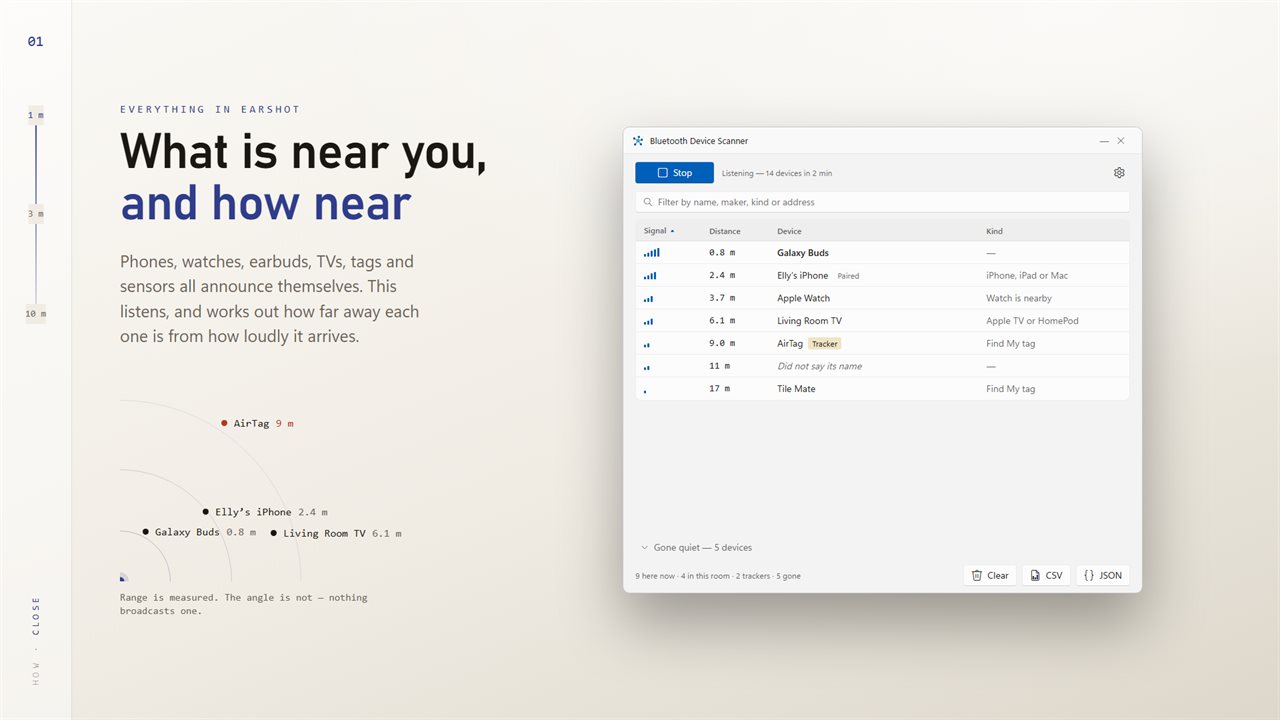
The Bluetooth Device Scanner window listing Galaxy Buds, an iPhone, an Apple Watch, a TV, an AirTag and a Tile with signal bars and distances
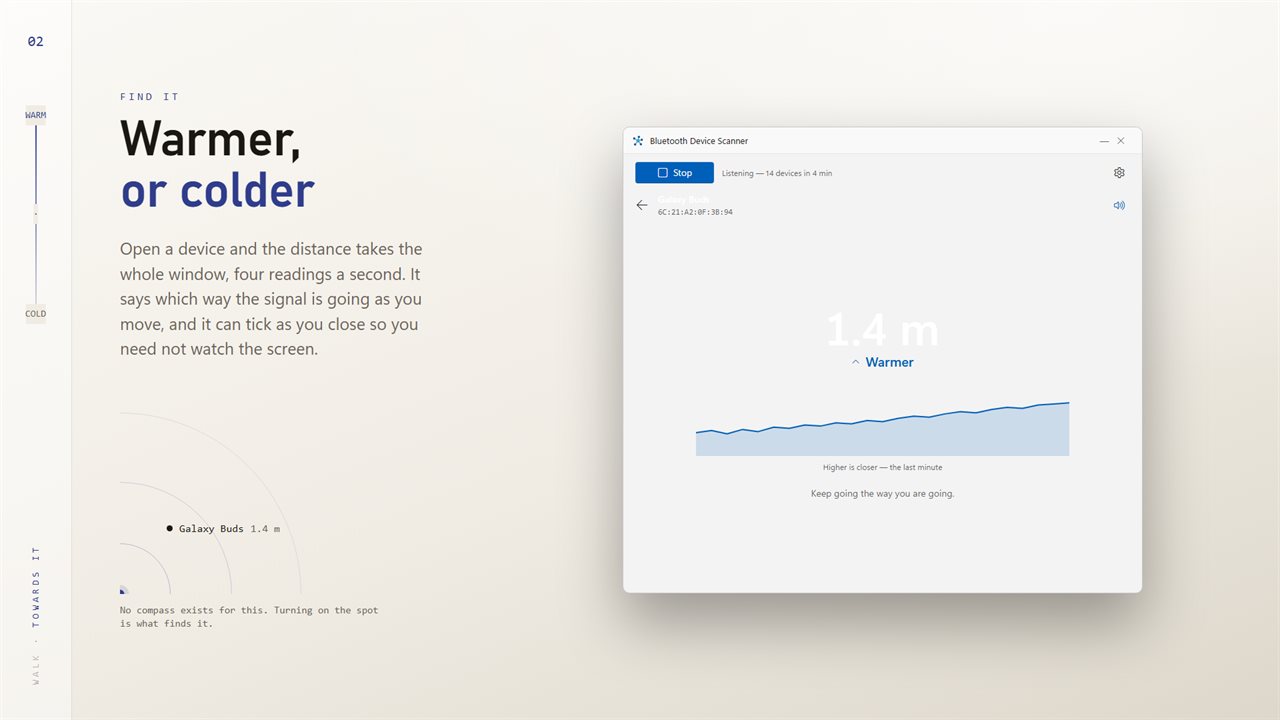
Find it: one device, four readings a second, warmer or colder as you walk.
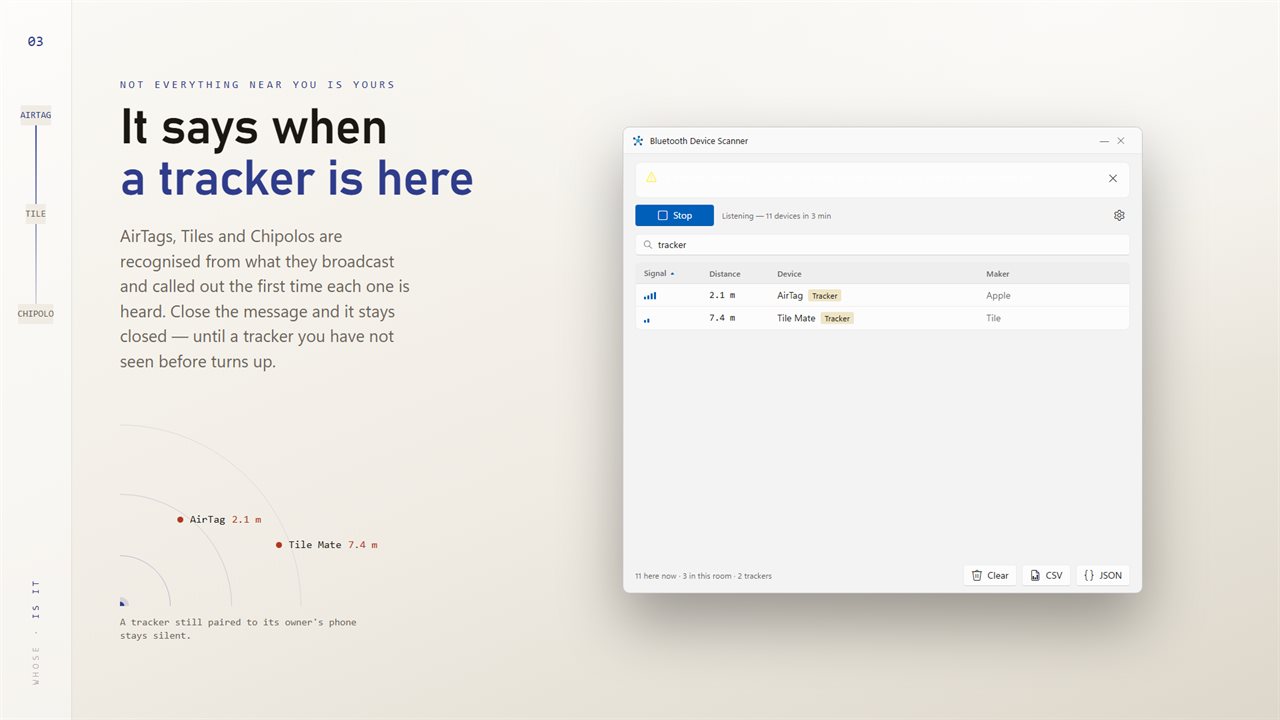
It says when an AirTag, Tile or Chipolo is nearby — and which one.
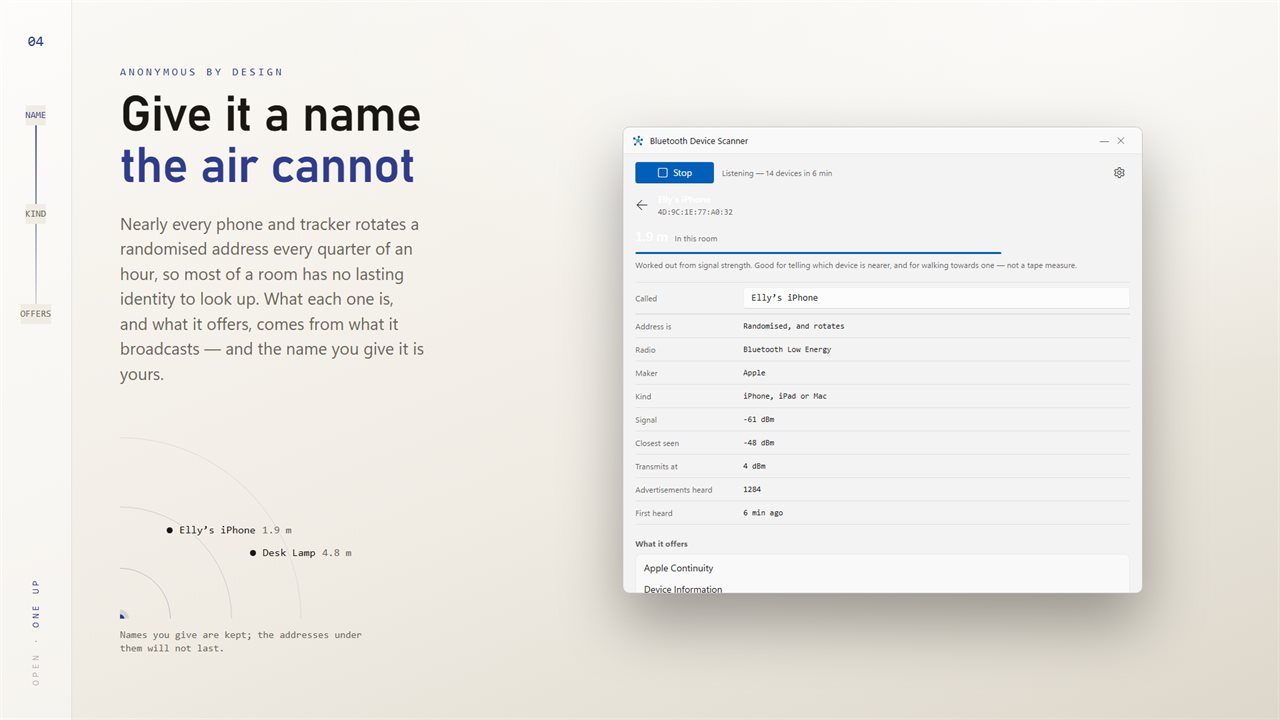
What a device is, what it offers, and a name you give it yourself.
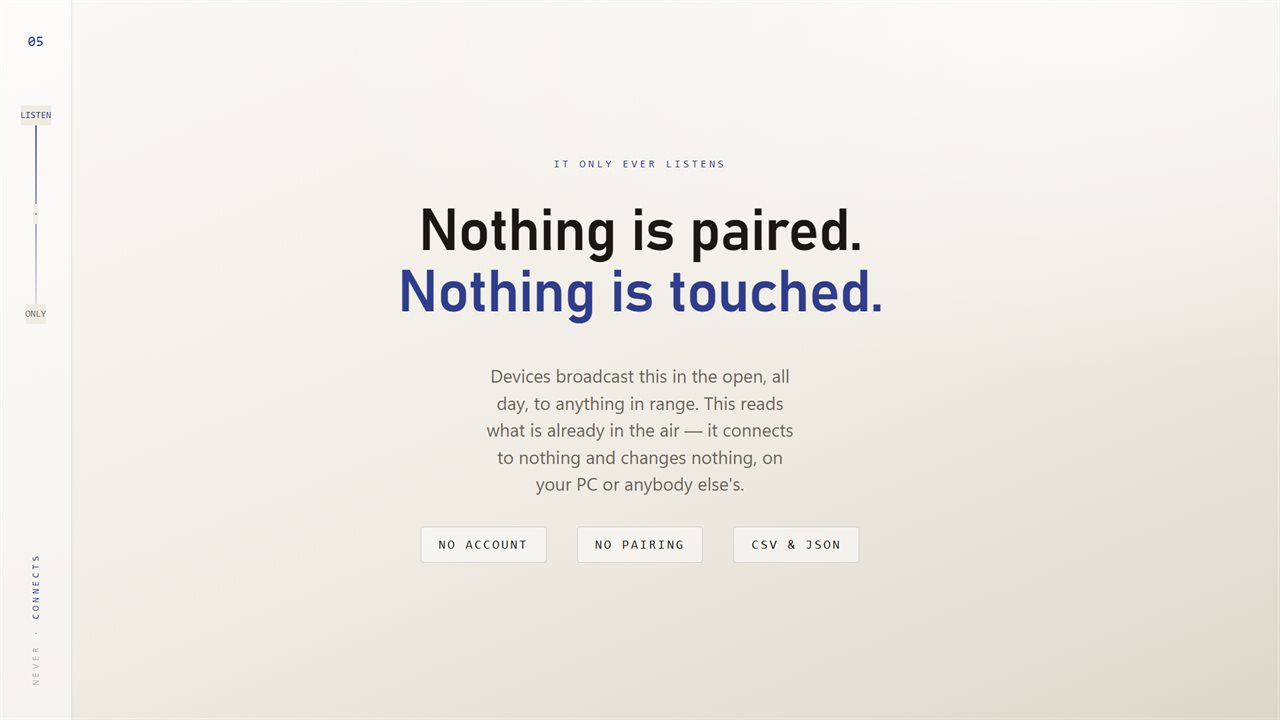
It only ever listens. Nothing is paired, connected to or changed.

Everything advertising around you, and how far away each one is.

190,000+downloads of EvlarSoft apps
Signed by EvlarSoftVerified US publisher
14-day money-backNo questions asked
Updates includedNo upgrade fees
Right here · In this room · Nearby

Distance, not just signal

Each device's signal is turned into an estimate in meters, adjusted for open space, an ordinary room or walls in between.

AirTag · Tile · Chipolo

Trackers called out

Known trackers are recognized from what they broadcast and flagged the first time each one is heard.

60 makers · 32 services

What each device is

Makers are named from the company code a device broadcasts, and common services like Heart Rate or Battery are spelled out in words.

How a PC can tell how far away a device is

Most Bluetooth gadgets announce themselves several times a second so phones and computers can find them. Those announcements carry a name, sometimes a maker code, and arrive at a measurable strength.

Signal strength falls off with distance in a predictable way, so a strong signal means a device is close and a weak one means it is further off. Walls, bodies and furniture soften the signal, which is why the app lets you say what kind of space you are in.

It is an estimate, not a tape measure. It is very good at telling you which of two devices is nearer, and whether you are getting warmer as you walk. Bluetooth carries no direction, so to find a lost device, turn slowly on the spot and walk the way the reading improves.

How to find a Bluetooth device with your PC

Bluetooth Device Scanner lists every device advertising near you with a signal meter and an estimated distance. To track down one in particular, use Find it and follow the reading.

  • Set the kind of space you are in, open space, an ordinary room or walls in between, so the distances fit it.
  • Find the device in the list, open it, and press Find it.
  • Carry the PC and watch the large distance readout, which refreshes four times a second with the last minute of signal drawn beneath.
  • Walk the way it says warmer, and turn on the ticking to sweep the room without looking at the screen.
  • If it holds steady, turn slowly on the spot; your body blocks the signal, so walk toward the direction where it peaks.

What a Bluetooth scanner can tell you about each device

Open any device for its details: the maker, named from the company code it broadcasts for sixty makers, the signal in dBm, its transmit power and the services it offers. Thirty-two services are spelled out in words, such as Heart Rate, Battery, Keyboard or Mouse, and Eddystone Beacon.

Apple devices are told apart from what they broadcast, so you see AirPods or Beats, Watch is nearby, Apple TV or HomePod, or Find My tag rather than a bare address. Devices Windows is already paired with are listed too, marked as paired or connected.

Reading the list: rotating addresses and devices that go quiet

Nearly every phone and tracker advertises a randomized address that changes every quarter of an hour. That is deliberate, and it is why one phone can appear as several rows over an evening. A name you give a device is kept against its address for as long as that address lasts.

Devices advertise in bursts, so one that goes silent for a minute has usually not left. Instead of vanishing from under the pointer, it moves to a Gone quiet section below the list, folded away until you open it.

Scanning for AirTags, Tiles and Chipolos

Trackers are recognized from what they broadcast and called out the first time each one is heard. Close the message and it stays closed until a tracker you have not seen before appears, which raises it again.

The scanner only listens. It never pairs or connects, changes nothing on your PC or anyone else's device, and nothing leaves the PC unless you save the list yourself as CSV or JSON.
Bluetooth Device Scanner features

  • Live device listEverything advertising nearby, with a signal meter and distance.
  • Smoothed distance estimatesThe number holds still instead of flickering, and moves as the device does.
  • Room settingOpen space, a room or walls in between, applied to every distance on screen.
  • Find it modeA large readout four times a second, with warmer, colder or holding steady.
  • Optional tickingBeats faster as you close in, so you can search without watching the screen.
  • Tracker alertsAirTags, Tiles and Chipolos are flagged the first time each one is heard.
  • Makers and services namedSixty makers and thirty-two services shown in words.
  • Your own device namesKept against a device's address for as long as it lasts.
  • Gone quiet sectionSilent devices move below the list instead of disappearing.
  • Listen onlyNo pairing, no connecting, no account, with CSV and JSON export.

What people use it for

Finding lost earbuds

Using Find it to walk toward a case that slipped down the sofa.

Checking for trackers

Seeing whether an AirTag, Tile or Chipolo is broadcasting nearby.

Testing Bluetooth gear

Checking what a device advertises, its signal in dBm and the services it offers, then exporting the list as CSV or JSON.

What's new in 2.0

  • Signal and distance keep updating live
  • Find it mode, with optional ticking that speeds up as you get closer
  • Distances corrected for each device's own transmit power
  • AirTags, Tiles and Chipolos identified by name
  • Devices that go quiet move to their own section instead of vanishing
  • Your own names for devices, and CSV and JSON export

Questions

Anything else? Ask us

Does it pair with or connect to anything?

No. It only listens to what devices broadcast in the open, and changes nothing on them or on your PC.

Why does one phone show up several times?

Phones and trackers change their Bluetooth address every so often for privacy, so the same device can look new. Names you give are kept against the address it is using.

Can it prove there is no tracker on me?

No. It finds trackers that are broadcasting. A tracker sitting near its owner's phone can stay quiet, so an empty list is not a guarantee.

Why don't my keyboard and mouse show a distance?

Many of them use older Bluetooth that does not broadcast. They are listed from Windows' own paired devices instead, without a signal reading.

Does it need the internet or an account?

No. Everything happens on your PC.

Which versions of Windows does it run on?

Windows 10 (version 1809 or later) and Windows 11.

Is it a subscription?

No. Bluetooth Device Scanner is a one-time purchase of $2.99, and updates are included.

How do I get it?

Buy it on this page and your license key arrives by email. If the button says Notify me, Bluetooth Device Scanner is not on sale here yet; leave your email and we will tell you when it is.