EEvlarSoft

Sudoku: The Compositor

A sudoku game for your PC that tells you which technique each grid needs, teaches it in plain words, and never leaves you with a guess.

Buy for $2.99
One payment. No subscription.
14-day money-back guarantee.
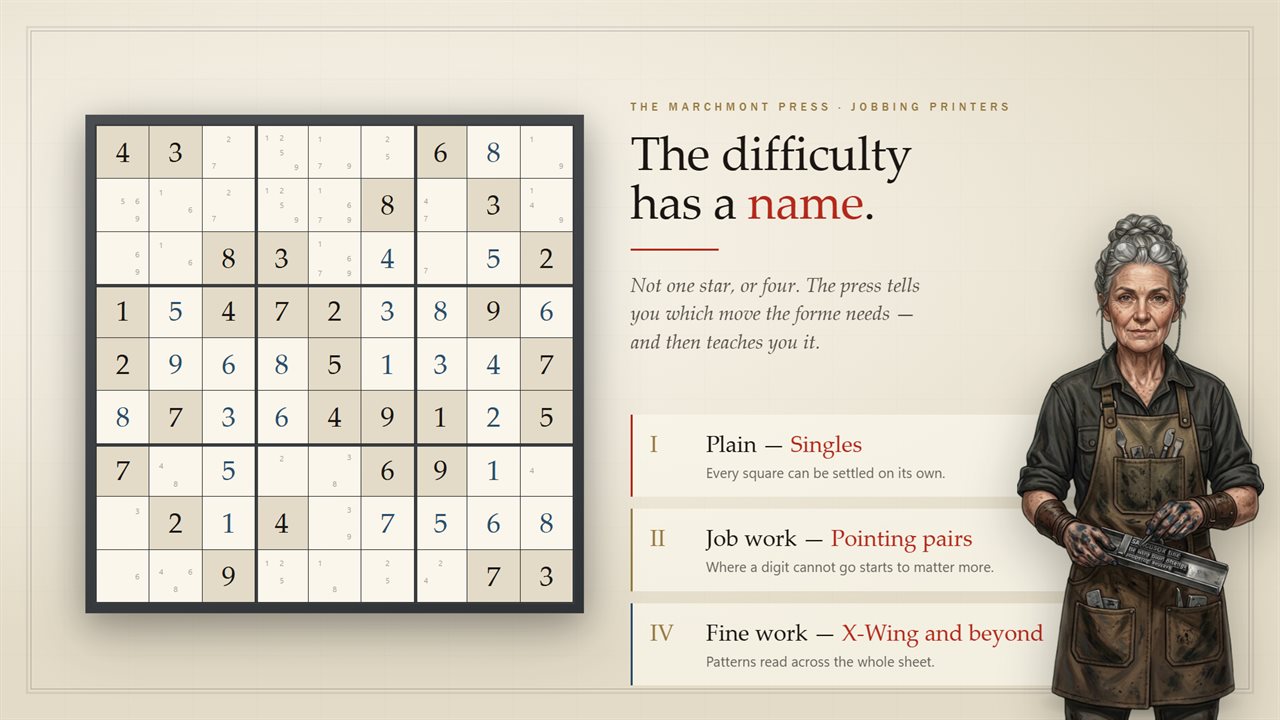
The difficulty has a name: singles, pointing pairs, pairs and triples, X-Wing.
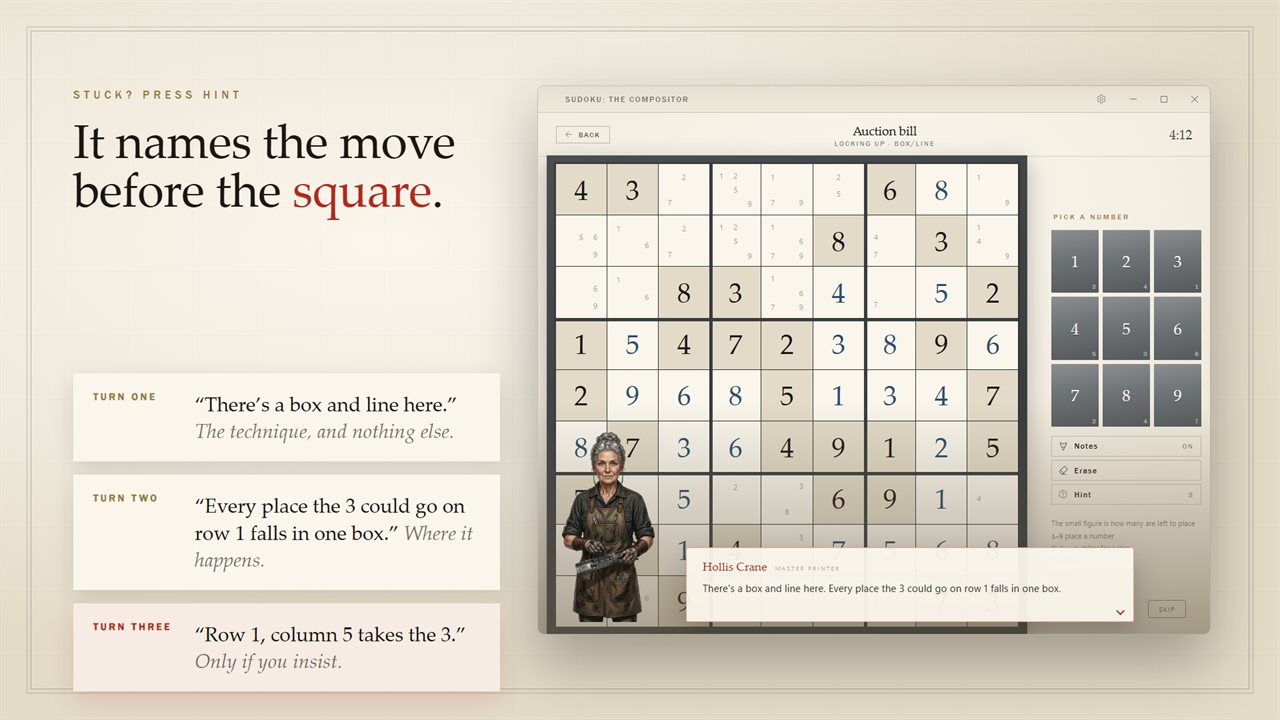
The hint names the move first, explains it second, and only then points at the square.
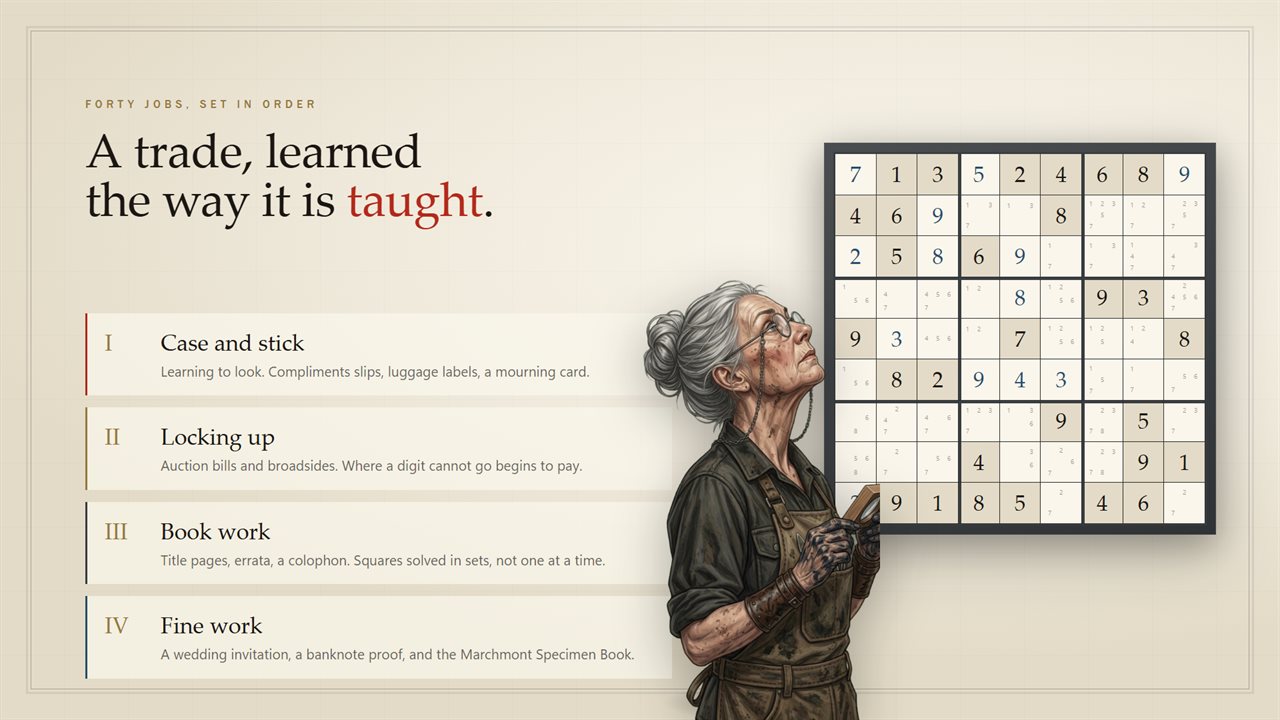
Forty jobs in four chapters, and every technique taught the first time it is needed.
Four grades to set yourself, and a daily job from the date. Never a guess in any of them.

The difficulty has a name: singles, pointing pairs, pairs and triples, X-Wing.

190,000+downloads of EvlarSoft apps
Signed by EvlarSoftVerified US publisher
14-day money-backNo questions asked
Updates includedNo upgrade fees

A sudoku download that shows you how to get better

This sudoku download is for players who want puzzles that stay interesting after the easy ones stop being a challenge. Sudoku: The Compositor runs on your Windows PC, and instead of an Easy, Medium or Hard label, each grid is graded by the hardest reasoning step it requires.

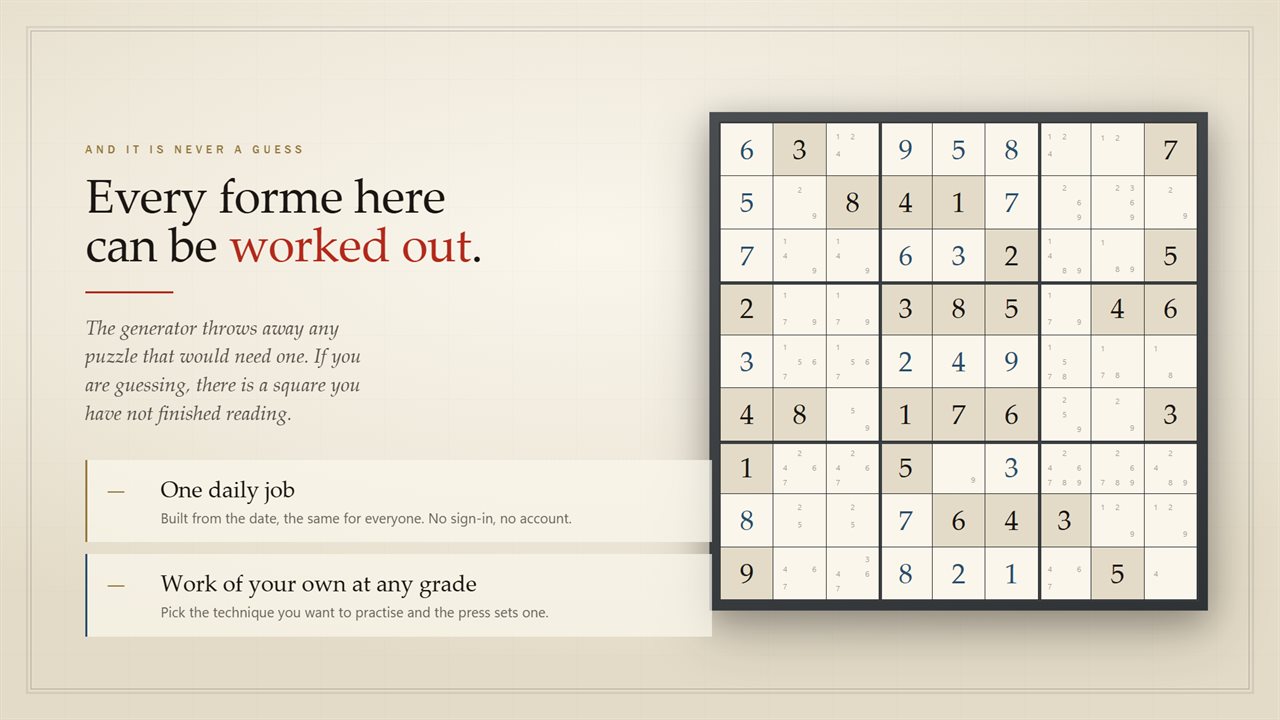
Before a puzzle reaches you, a built-in solver works through it one deduction at a time. If the solver cannot finish it by logic alone, the grid is thrown away and another is made. What you get is always solvable by thinking, with exactly one answer, and the label tells you honestly what kind of thinking that is.

There are four grades. Plain needs only singles. Job work brings in pointing pairs. Book work asks for naked pairs, hidden pairs and triples. Fine work is where X-Wing, XY-Wing and Swordfish turn up. You can stay at the level that suits you or climb deliberately, knowing what the next step up will ask of you.

Sudoku strategies, taught when a grid first needs them

The story mode puts you in a small print shop as the new apprentice. The forty jobs run through four chapters, and Hollis Crane, who runs the press, introduces each strategy at the moment a puzzle first calls for it. She explains it once, in ordinary language, and moves on.

Eleven techniques are covered in all. These are the names you will see in the game and in most sudoku guides, so what you learn carries over to puzzles anywhere:

  • Full house, naked single and hidden single
  • Pointing pair and box/line reduction
  • Naked pair, hidden pair and naked triple
  • X-Wing, XY-Wing and Swordfish

Advanced sudoku techniques without reading a manual

Written explanations of an X-Wing or a Swordfish are hard to follow because they describe a pattern in the abstract. Here the hint does the explaining on the grid in front of you, in three presses of H or the Hint button.

The first press names the technique that is available right now. The second highlights the row, column or box where it applies and says why it works there. The third points at the exact square, selects it, and tells you which digit goes in or which candidate comes out. Stop after the first press if you only want a nudge.

If you have entered a wrong number and nothing can follow, the hint says so instead of sending you in circles. Squares that clash with another digit are marked as you play, so a mistake does not quietly cost you the rest of the puzzle.

Daily sudoku and puzzles of your own

Outside the story, Your own work starts a fresh grid at any of the four grades whenever you like, and the game keeps your best time for each. The Daily job is generated on your PC from the calendar date, so everyone playing gets the same grid. Monday and Tuesday are Plain, and the grade rises through the week until Sunday is Fine work. Finish one each day and the game counts your streak.

What the game does

  • Grades every puzzle by the hardest technique a solver needed to finish it
  • Rejects any grid that cannot be completed by logic, so none require trial and error
  • Three-step hintsName the move, show where it applies, then point at the square
  • Forty story puzzles across four chapters, each chapter teaching its own grade
  • Candidate notes filled in automatically, or written by hand with Shift and a number
  • Full keyboard playArrow keys or WASD to move, 1 to 9 to place, P for notes mode, Del to erase
  • A number panel for mouse players that shows how many of each digit are still to place
  • Best time per grade, a daily streak, and your unfinished grid saved when you quit

Who it suits

Sudoku for beginners

Start on Plain and the first chapter. Every square can be settled on its own, and the hint explains the reasoning rather than just filling in a number.

Players stuck at hard

If hard puzzles elsewhere feel like guesswork, the problem is usually a technique you have not met. Book work and Fine work introduce them one at a time.

A puzzle with your coffee

The daily grid takes a few minutes early in the week and more by Sunday, and the streak gives you a reason to come back.

Questions

Anything else? Ask us

How many puzzles are there?

There is no fixed set, because each grid is made when you start it. The story has 40 jobs across four chapters, and outside it you can start as many new grids as you like at any of four grades, plus one daily grid.

What difficulty levels are there?

Four, each named after the technique it needs: Plain (singles), Job work (pointing pairs), Book work (pairs and triples) and Fine work (X-Wing and beyond). Each grid is labeled with the hardest technique the solver actually needed to finish it.

Does every puzzle have exactly one solution?

Yes. Before you see a grid, a solver finishes it by logic alone, with no guessing, and a grid that can be solved that way has only one answer.

Are there hints and pencil marks?

Yes. A hint comes in three steps: it names the technique, then explains where it applies, then points at the square. The game fills in candidate notes for you by default; turn off Strike out candidates in Settings to write your own with Shift and a number.

If I quit in the middle of a puzzle, is it saved?

Yes. The grid you were on, with your notes, is kept and offered to continue next time. One unfinished grid is kept at a time, and an unfinished daily grid is dropped once the day changes.

Is there a daily puzzle, and does it need the internet?

Yes, there is a daily grid, and no, it does not need a connection. It is made on your PC from the date, so everyone gets the same one. Monday and Tuesday are Plain, and the grade rises through the week to Fine work on Sunday.

What is an X-Wing in sudoku?

An X-Wing appears when a digit can go in only two squares in each of two rows, and those squares sit in the same two columns. The digit must occupy one diagonal pair, so it can be removed from every other square in those two columns. The game teaches it in the Fine work chapter.

Can I play with only the keyboard?

Yes. Move with the arrow keys or W, A, S and D, type 1 to 9 to place a digit, hold Shift with a number to add a note, press P to switch notes mode on or off, Delete, Backspace or 0 to erase, and H for a hint.

What is the difference between a naked single and a hidden single?

A naked single is a square where only one digit is still possible. A hidden single is a digit that can go in only one square of a row, column or box, even though that square has other candidates. Both are Plain work in the game, and the hint names whichever one is available.

Which versions of Windows does it run on?

Windows 10 (version 1809 or later) and Windows 11.

Is it a subscription?

No. Sudoku: The Compositor is a one-time purchase of $2.99, and updates are included.

How do I get it?

Buy it on this page and your license key arrives by email. If the button says Notify me, Sudoku: The Compositor is not on sale here yet; leave your email and we will tell you when it is.