EEvlarSoft

Nonograms: The Glasswright

A nonogram game for your PC with picture puzzles that always solve by logic, hints that teach the next step, and two glaziers who talk you through it.

Buy for $2.99
One payment. No subscription.
14-day money-back guarantee.
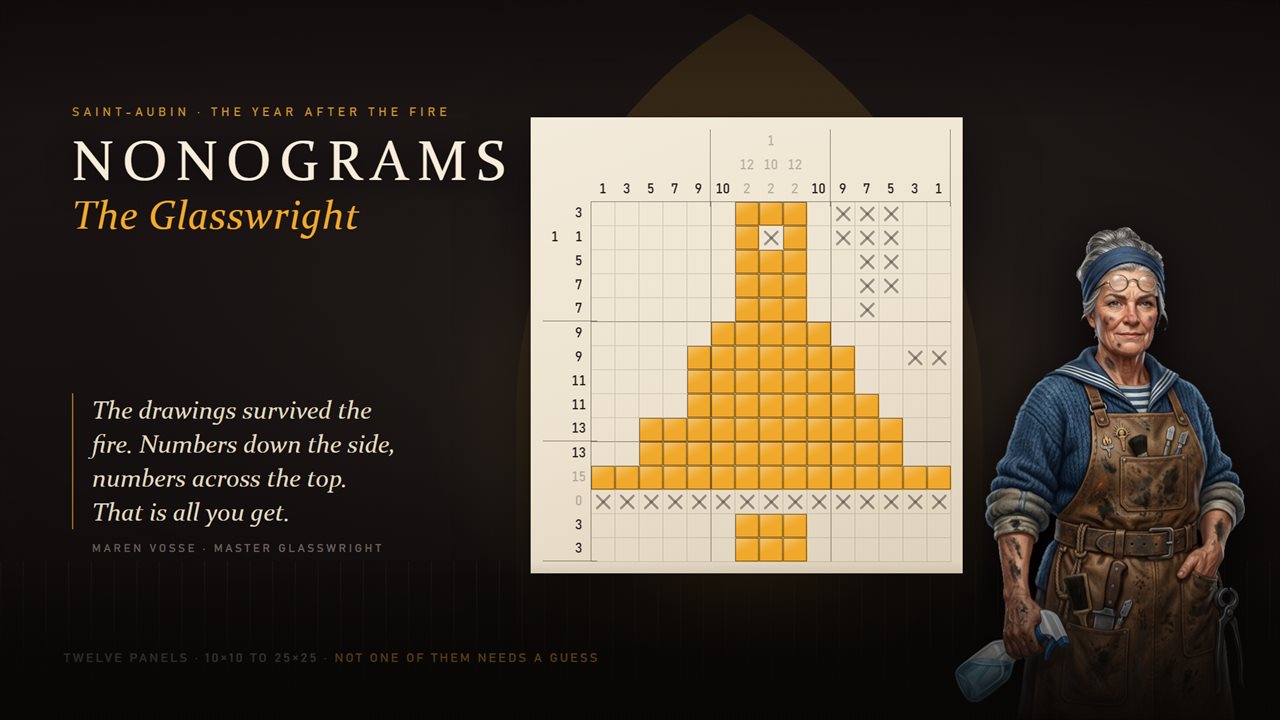
Numbers down the side, numbers across the top. That is all you get.
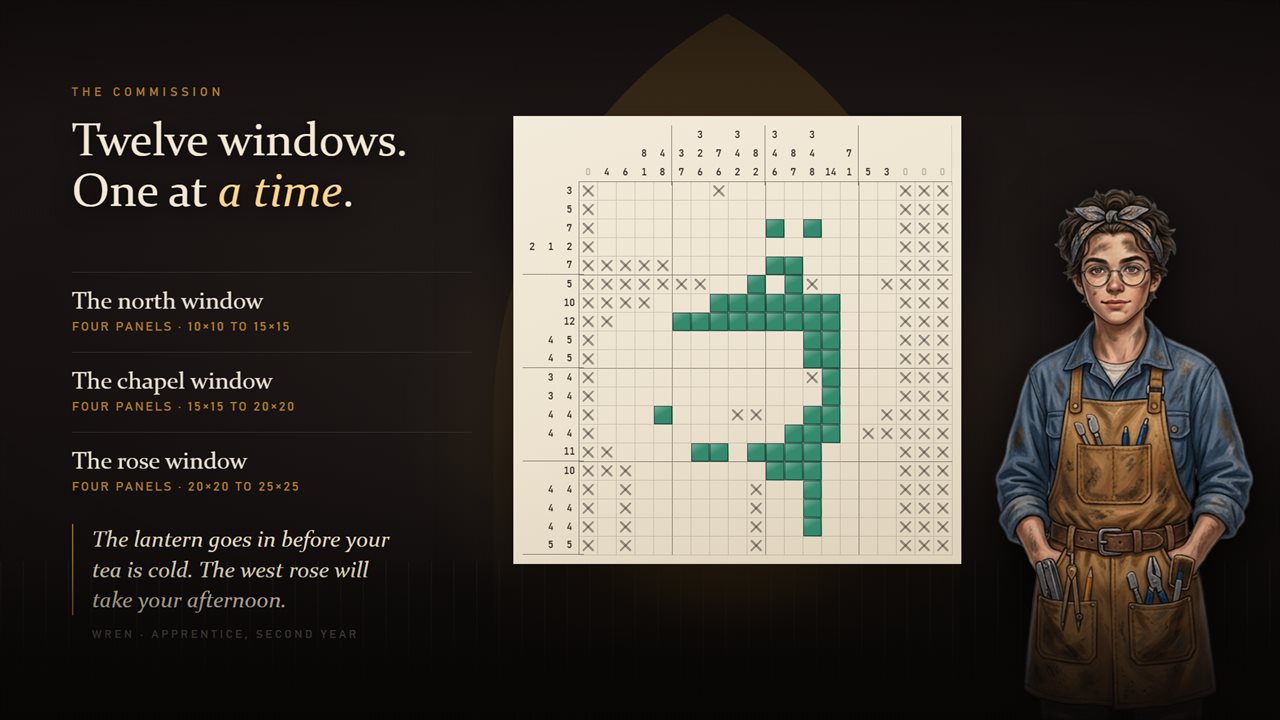
Twelve drawn panels, in three chapters, from 10x10 up to 25x25.
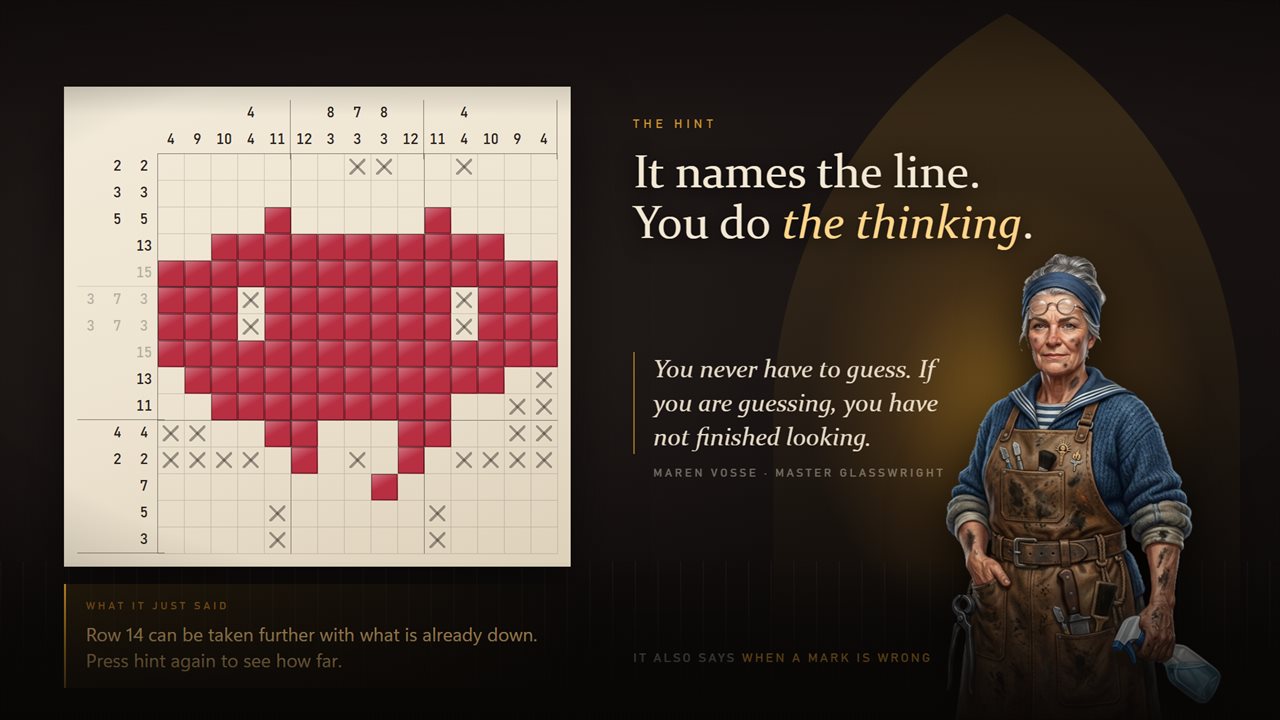
The hint names the line you could work out next - and says when a mark is wrong.
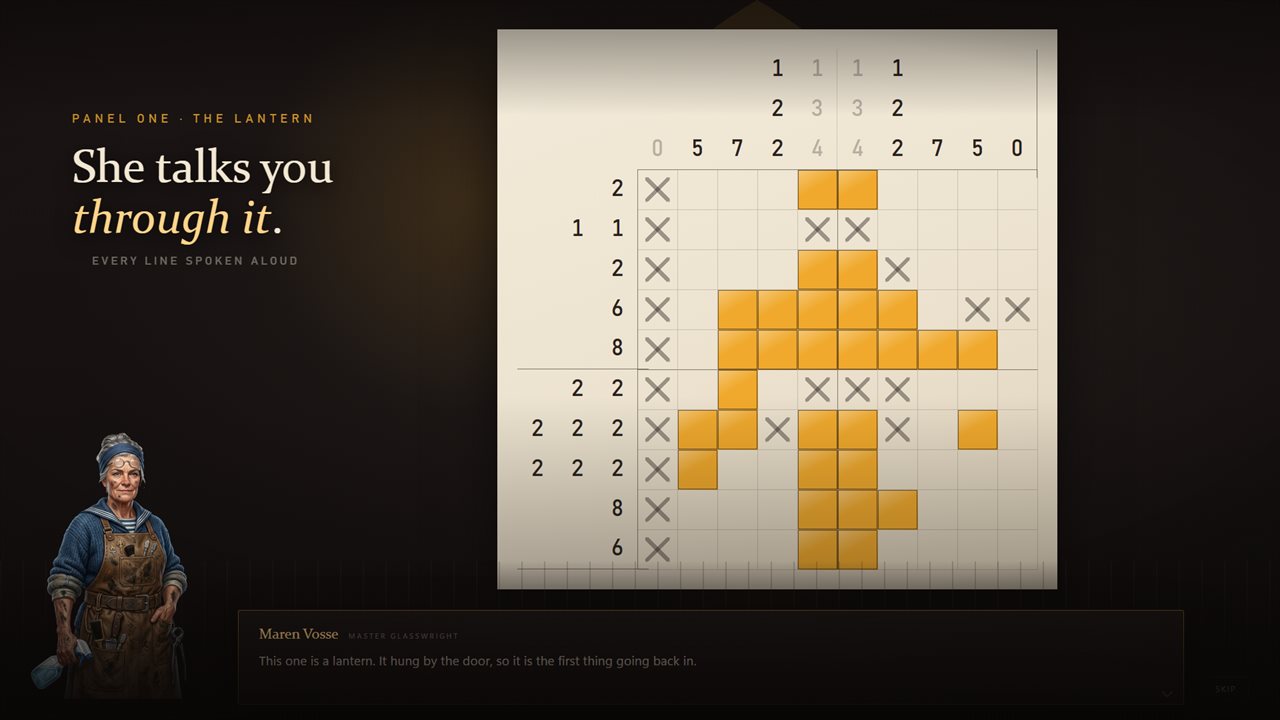
Maren sets you off on the first panel - and every line she says is spoken aloud.
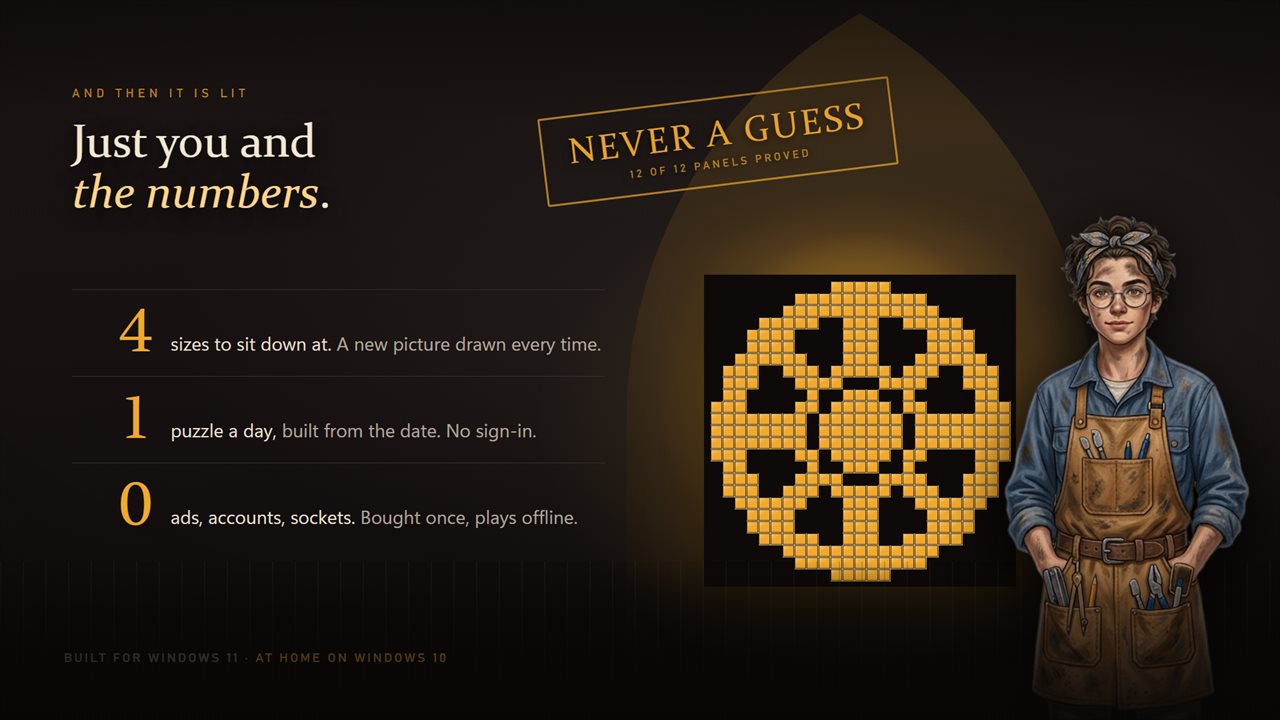
Finish one and it lights. Four open-bench sizes and a daily puzzle after that.

Numbers down the side, numbers across the top. That is all you get.

190,000+downloads of EvlarSoft apps
Signed by EvlarSoftVerified US publisher
14-day money-backNo questions asked
Updates includedNo upgrade fees

A nonogram game you can always finish by reasoning

A nonogram, also called a griddler, hanjie or picture cross, is a grid with number clues beside each row and column. Each clue lists the runs of filled squares in that line, in order, with at least one gap between runs. Cross-check rows against columns and a single picture emerges.

Nonograms: The Glasswright is a nonogram game built on one promise: you never have to guess. Every puzzle, whether a story panel, a bench grid or the daily, is first run through a solver that works one row or column at a time. Anything it cannot finish by that line-by-line logic is thrown away before you see it.

The story is a restoration. A fire has taken the windows of the church at Saint-Aubin, and as the new apprentice you rebuild twelve panels from the surviving drawings, starting with a 10x10 lantern and ending on a 25x25 rose window. Maren, who runs the workshop, and Wren, a year ahead of you, speak every line aloud, hints included.

How to play nonograms: the first techniques

  • Start with the biggest clues. In a 10-square row, a clue of 8 must cover the middle six squares wherever it sits, so fill those first.
  • Add the clues and gaps. A row reading 3 2 4 needs at least 3+1+2+1+4 = 11 squares; when that equals the row length, the whole line is known.
  • Cross off what cannot be filled. A right-drag marks squares as empty, and an empty square splits a line into smaller pieces that are easier to reason about.
  • Work the edges. A filled square on the border anchors the first or last run of that line.
  • Alternate. Every square you settle in a row becomes a fact for the column that crosses it.

Nonogram tips for when you get stuck

Past 15x15, the opening techniques stop finishing lines on their own and the work becomes small, local deductions. Three habits carry most players through.

When you are truly stuck, the hint points to a line rather than a square, so the next deduction is still yours to make. Turning on Cross off finished lines in settings marks the rest of a completed line empty for you, which saves clicks on large grids without making any decision you could not make yourself.

  • Look for overlap again after every change. A run that could sit anywhere in a 20-square line may be pinned to a 9-square stretch once a crossed-off square appears, and the overlap rule applies to that shorter stretch.
  • Count from the wall. When a run touches the border, or a crossed square, its length tells you exactly where it ends and the next square must be empty.
  • Check the small clues last. A 1 has many places to go; leave it until the big runs around it are settled.

Daily nonogram and the open bench

The daily puzzle is drawn from the date on your own PC, so everyone gets the same picture on the same day. It grows over the week: 10x10 on Monday and Tuesday, 15x15 midweek, 20x20 on Friday and Saturday, and 25x25 on Sunday. A streak counts the days in a row you have solved it.

The open bench offers the same four square sizes whenever you like, with a newly generated, newly proved picture each time and best times kept per size.

In the game

  • Every puzzle proved solvable by line logic, with no guessing
  • Twelve story panels from 10x10 to 25x25, some taller than wide
  • Open bench at 10x10, 15x15, 20x20 and 25x25
  • A daily puzzle with a streak
  • Two-step hints that name a line, then fill it
  • Mistake checks on request, not counted as hints
  • Mouse and keyboard playArrows, Space to fill, X to cross off, H for a hint
  • Ctrl+Z undoes a whole stroke, and zoom for large grids
  • Optional Cross off finished lines, plus separate Sound, Music and Voices switches
  • Progress kept when you quit in the middle of a puzzle

Questions

Anything else? Ask us

Do any of the nonograms need guessing?

No. Every puzzle, including the story panels, the open bench and the daily, is checked by a solver that works one row or column at a time, and a puzzle it cannot finish that way is thrown out.

What puzzle sizes are there?

The open bench has four square sizes: 10x10, 15x15, 20x20 and 25x25. The twelve story panels run from 10x10 to 25x25, and a few of them are taller than they are wide, such as 10x15 and 20x25.

How do hints work?

The first press names a row or column you can take further with what is already down. Press again and it fills that line in for you. Hints are counted next to your finishing time.

Does it show mistakes as I make them?

No, only when you ask for a hint. If something you marked is wrong, the hint says so and points at the row instead of offering a new line, and that check does not count as a hint.

What are the controls?

Drag to fill squares and right-drag to cross them off, and Ctrl+Z undoes a whole stroke. On the keyboard, the arrow keys move, Space fills, X crosses off and H asks for a hint. Zoom with the + and - buttons, the + and - keys, or Ctrl and the mouse wheel.

Are there color nonograms?

No. Every puzzle is black-and-white: each square is either filled or left empty.

Is a nonogram the same as picross or griddlers?

Yes. Nonogram, picross, griddlers, hanjie and picture cross are all names for the same puzzle: fill grid squares to match row and column clues and reveal a picture.

How do you solve a nonogram without guessing?

Work one line at a time. Fill the squares every possible placement of the clues agrees on, cross off the squares none of them can reach, then move to the crossing lines and repeat. On a well-made puzzle, like every one in this game, that loop alone finishes the picture.

What size nonogram should a beginner start with?

10x10. The first story panel, the lantern, is that size, and Maren and Wren explain each technique as it comes up. Move to 15x15 once a 10x10 takes you only a few minutes.

Which versions of Windows does it run on?

Windows 10 (version 1809 or later) and Windows 11.

Is it a subscription?

No. Nonograms: The Glasswright is a one-time purchase of $2.99, and updates are included.

How do I get it?

Buy it on this page and your license key arrives by email. If the button says Notify me, Nonograms: The Glasswright is not on sale here yet; leave your email and we will tell you when it is.