
Mahjong solitaire where every deal can be won
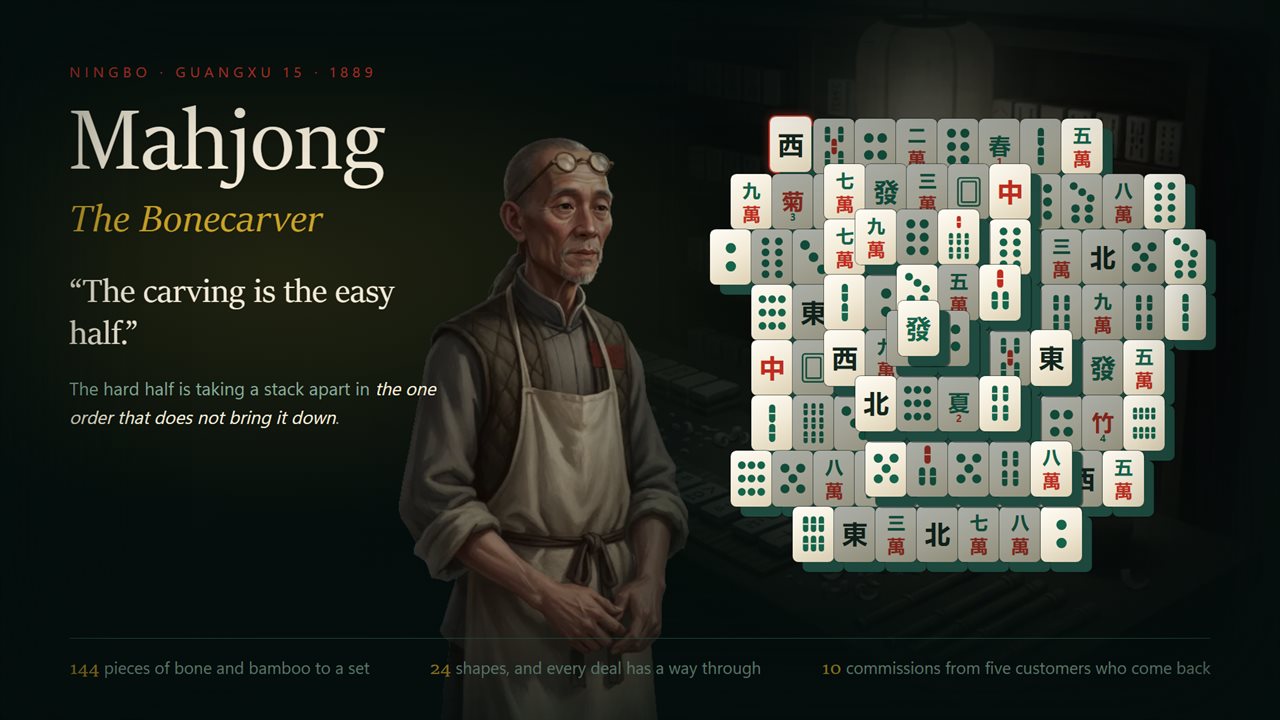
In most mahjong solitaire games the tiles are scattered onto the layout at random, and some deals simply cannot be finished. Mahjong: The Bonecarver builds each deal the other way round. It takes the empty layout apart in free pairs first, then places the tiles into that order backwards, so a complete solution exists every single time. You can still trap yourself by clearing pairs in the wrong order, but the board was never against you.
The game is set in the treaty port of Ningbo in 1889. You are the apprentice of an old carver whose hands have failed, finishing the work he can no longer do. Ten commissions over two years come from five customers, including a salt merchant, a ferryman and a magistrate, and each one returns for a second order that answers the first. Your conversations with them decide what each set is worth.
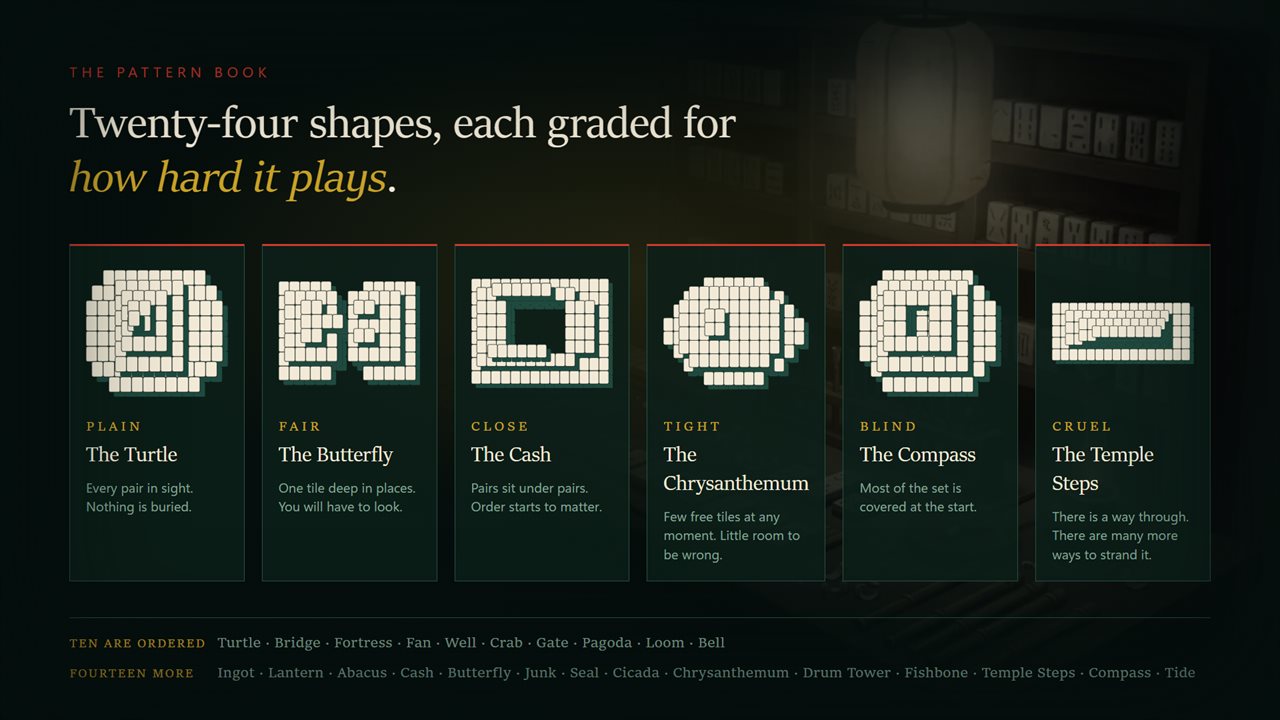
Another fourteen layouts come from the carver's pattern book with no one waiting on them, so there are 24 shapes in all, such as the Turtle, the Ingot and the Temple Steps.
How to play mahjong solitaire
The layout holds a full 144-tile set: 34 tile faces, circles, bamboo, characters, four winds and three dragons, four of each, plus four flowers and four seasons. Your goal is to clear the board in matching pairs.
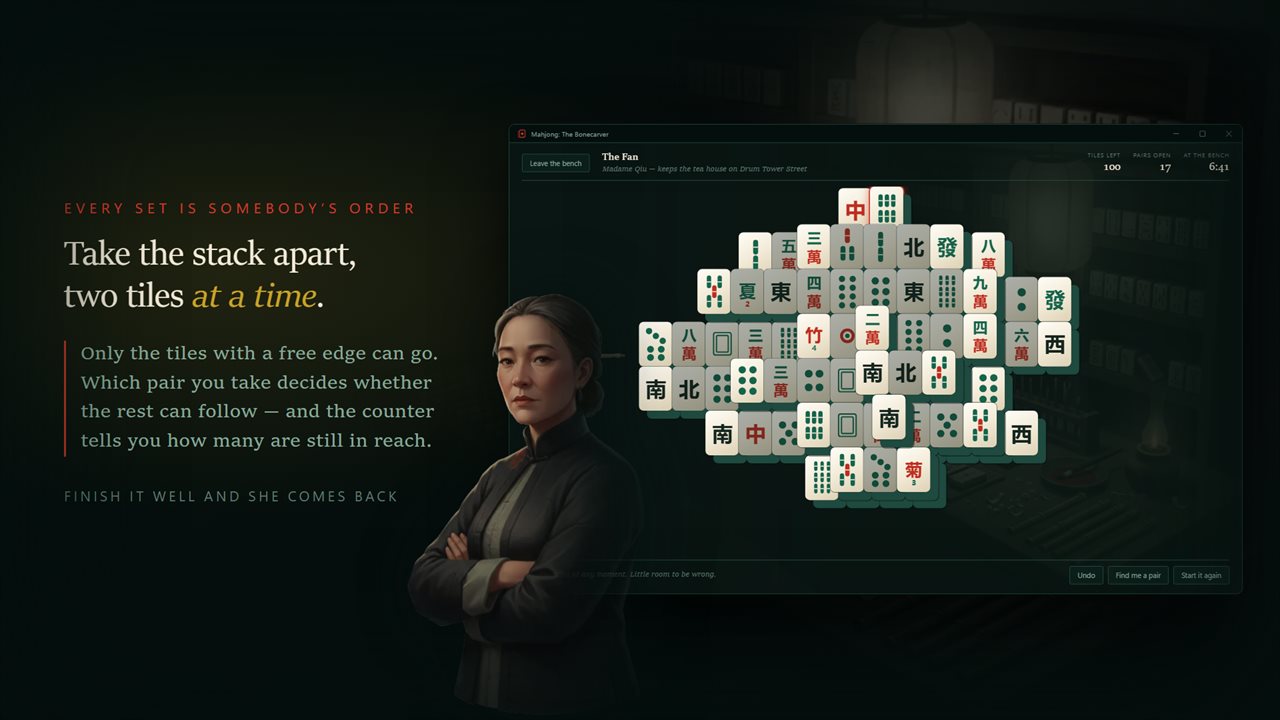
You may only take a tile that is free, which means two things: no tile rests on top of it, and at least one of its long sides, left or right, is open. Click two free tiles with the same face to remove them. Flowers are the exception to exact matching: any flower pairs with any flower, and any season with any season.
Mahjong solitaire strategy that actually helps
- Work on the tiles that unlock the most others: tops of tall stacks and the ends of long rows.
- When three free tiles share a face, stop and think. Taking the wrong two can bury the fourth.
- If all four of a face are free, clear them both pairs at once; nothing is lost.
- Do not race to clear the easy edges while the center stays locked.
- When stuck, use Undo. It goes back as far as you like, and undoing to the very start always returns a board that can be cleared.
Mahjong layouts graded by difficulty
Each of the 24 mahjong layouts carries a grade, and the six steps read like a description of the board rather than a number. Plain leaves every pair in sight. Fair buries tiles one deep in places. Close stacks pairs under pairs, so order starts to matter. Tight leaves few free tiles at any moment, Blind covers most of the set at the start, and Cruel has a way through with many more ways to strand it.
Shapes range from the familiar Turtle and Bridge to the Pagoda, the Junk, the Drum Tower and the Abacus, so the grade, not the size, is the guide to how hard a set will be.
Quick sets and saving your place
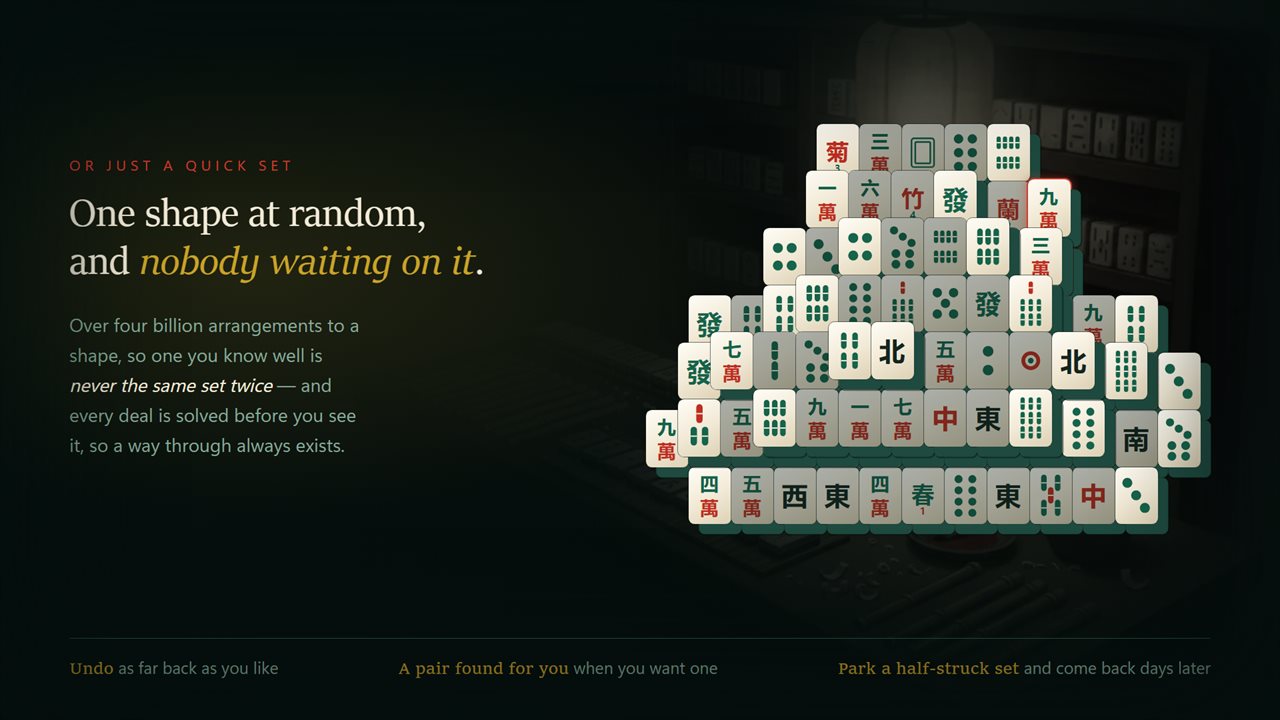
For a game without the story, One quick set deals any layout you have opened, or Deal me anything picks one at random. Every quick deal starts from a fresh random seed, one of roughly four billion, so a shape you know well is rarely laid out the same way twice. Quick sets are for one sitting; the story is where your progress is kept.