Chess against the computer, with someone sitting opposite
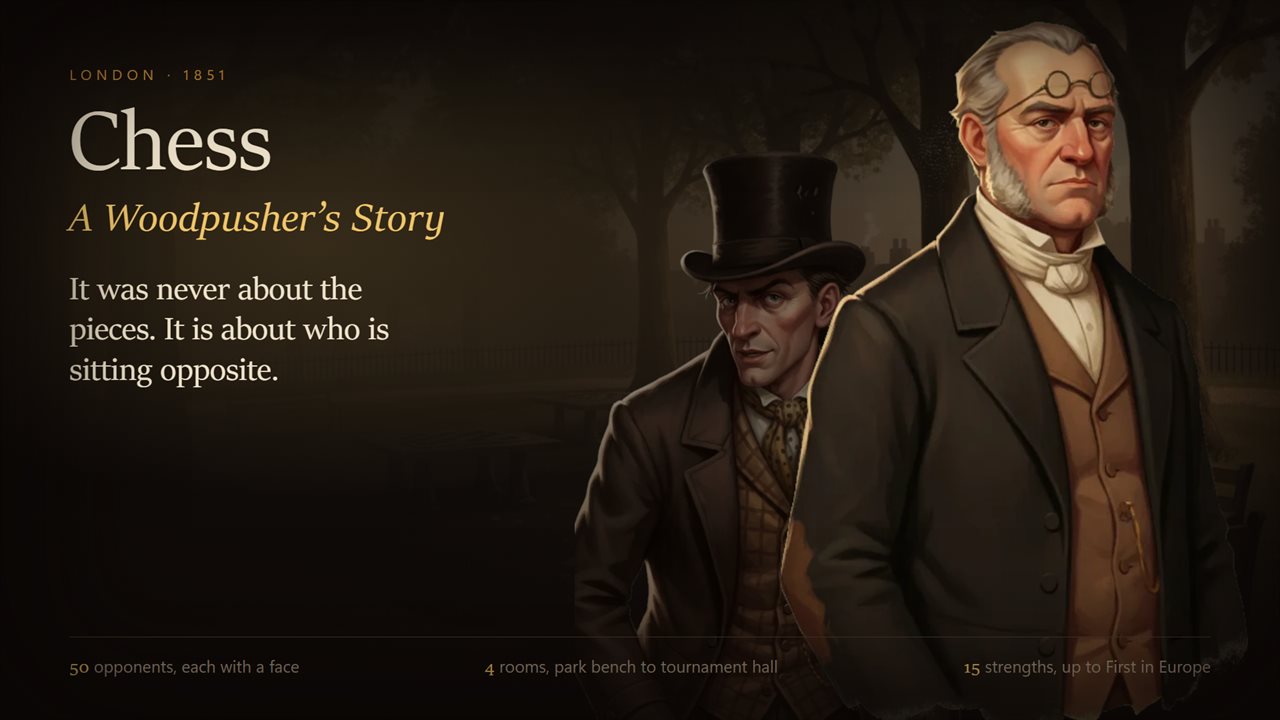
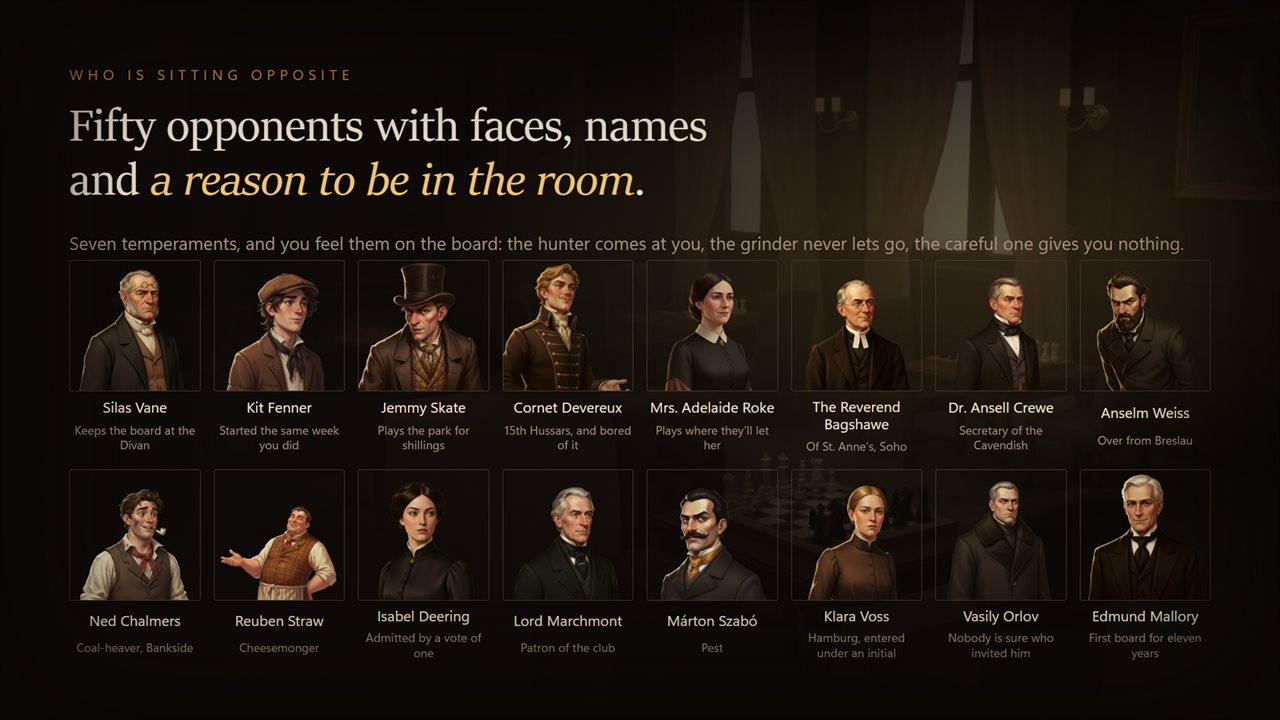
Playing chess against the computer usually means picking a level from a slider and facing an engine with no character. Chess: A Woodpusher's Story replaces the slider with people. Fifty named opponents sit across the board from you, each set at one of fifteen strengths and each with a temperament of their own, so two players at the same level can feel nothing alike.
The strengths run from Raw beginner through Park player, Club man, County and Master up to First in Europe, the label the game uses for the best player alive in 1851. A weak opponent here is weak for the reason real beginners are: its search stops too early to see the recapture coming, so it loses pieces the way people do rather than by playing random moves.
Temperament is the other half. Hunters and reckless players come straight at your king, grinders trade pieces and squeeze, careful players give you nothing to work with, and bookish ones stick to theory. Two opponents at the same strength can play nothing alike, so learning who you are facing becomes part of the game.
A chess story game across four rooms of Victorian London
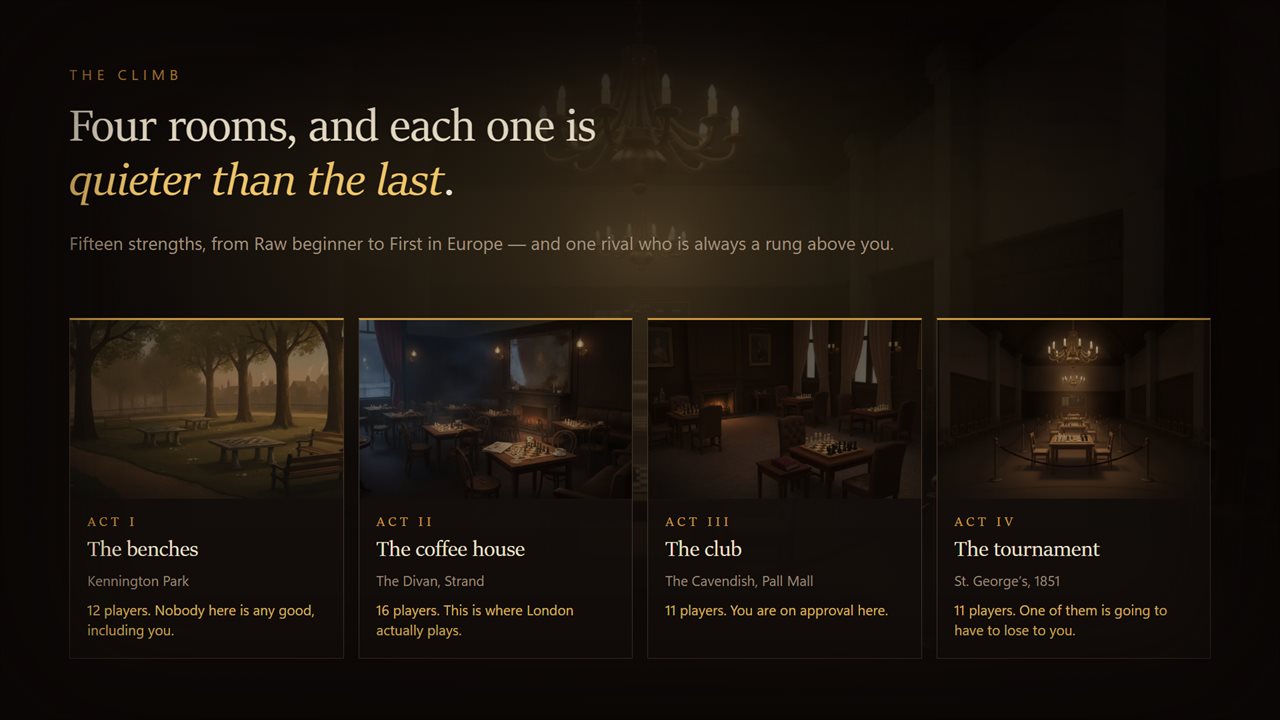
The career moves through four venues, each harder and quieter than the last: Kennington Park, the Divan on the Strand, the Cavendish Chess Club on Pall Mall, and St. George's, home of the international tournament. You arrive in each room as its weakest player and work your way up.
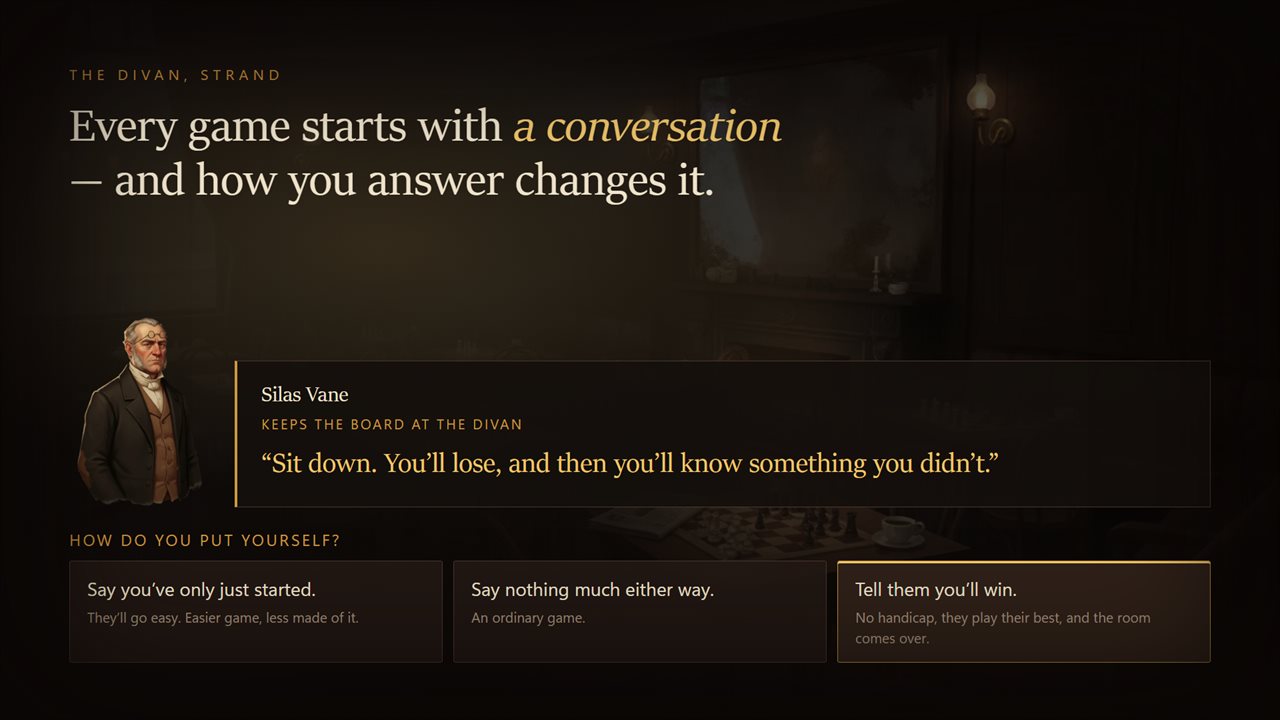
Every game starts with a short conversation, and what you say sets the terms. Say you've only just started and they go easy, often giving you odds. Say nothing much either way for an ordinary game. Tell them you'll win and they play their best with no handicap, while the room comes over to watch. Losing never ends the career; it costs you standing in the room, and you play on.
Odds chess: learning to win from a head start
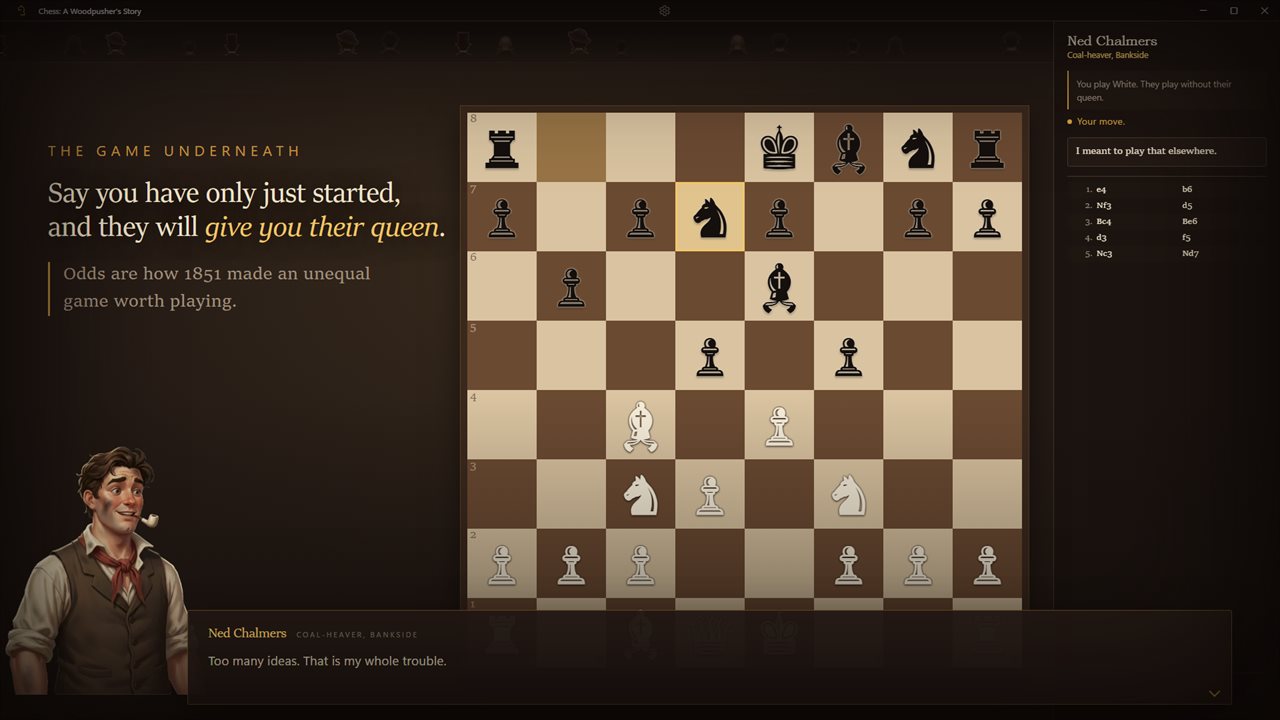
Handicap games were how stronger players took on weaker ones in the nineteenth century, and the story uses them the same way. Play modest and your opponent starts a piece down, with the missing men set out beside the board so you can see what was given. Early in the career the gift is the queen. As you climb it shrinks to a rook, then a knight, then pawn and move, and near the top it is gone entirely.
It is a gentle way in for chess beginners. A missing queen gives you room to make mistakes and still convert, and each step down the odds ladder asks for a little more technique. When you would rather prove yourself, the bold answer turns the handicap off.
Openings from the gambit era, and a rematch whenever you like
In even games, opponents open from a book of nine named lines rather than improvising from move one: the King's Gambit, the Evans Gambit, the Giuoco Piano, Philidor's Defence, the Scotch, the Vienna, the French, the Sicilian and the Queen's Gambit. Each character draws from the lines that suit their temperament, and an opponent avoids repeating the one they played against you last time.
Outside the story, a quick game lays out one opponent at each strength. Pick a face, then choose You play white, You play black or Let them decide. The record lists everyone you have played with your wins, losses and draws, and an unfinished story game waits under Continue.