No guess Minesweeper: what it means and why it matters
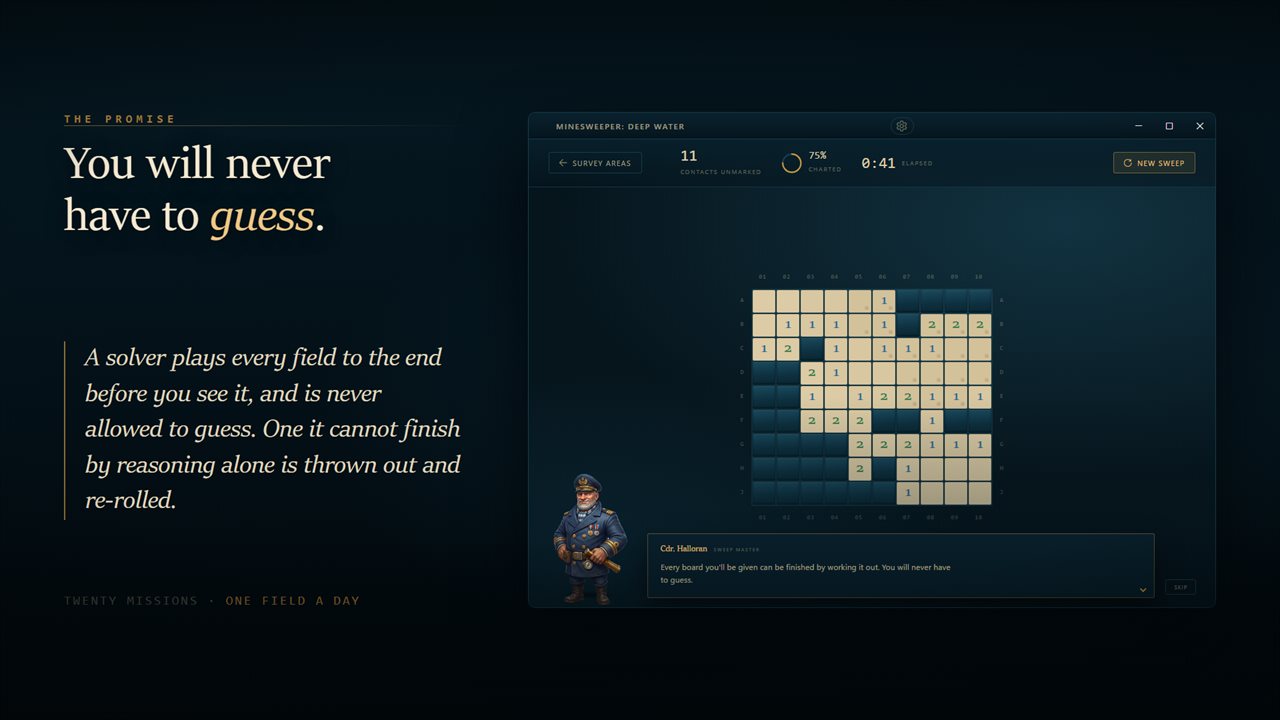
Classic Minesweeper places mines at random, and many boards end in a 50/50 that no amount of skill can solve. No guess Minesweeper removes that. Before a field reaches you, a solver plays it to the end using logic alone, never guessing; any field it cannot finish that way is discarded and a new one rolled.
Minesweeper: Deep Water applies that test to its 20 campaign missions and to the daily field. The game opens the starting area for you, and from there every square can be worked out from the numbers. If you hit a contact, there was a deduction you missed.
The three open areas stay classic on purpose, for players who enjoy the gamble and the speed race that comes with it. Pick the mode by what you want from a session: certainty, or luck plus pace.
A Minesweeper campaign that changes the rules
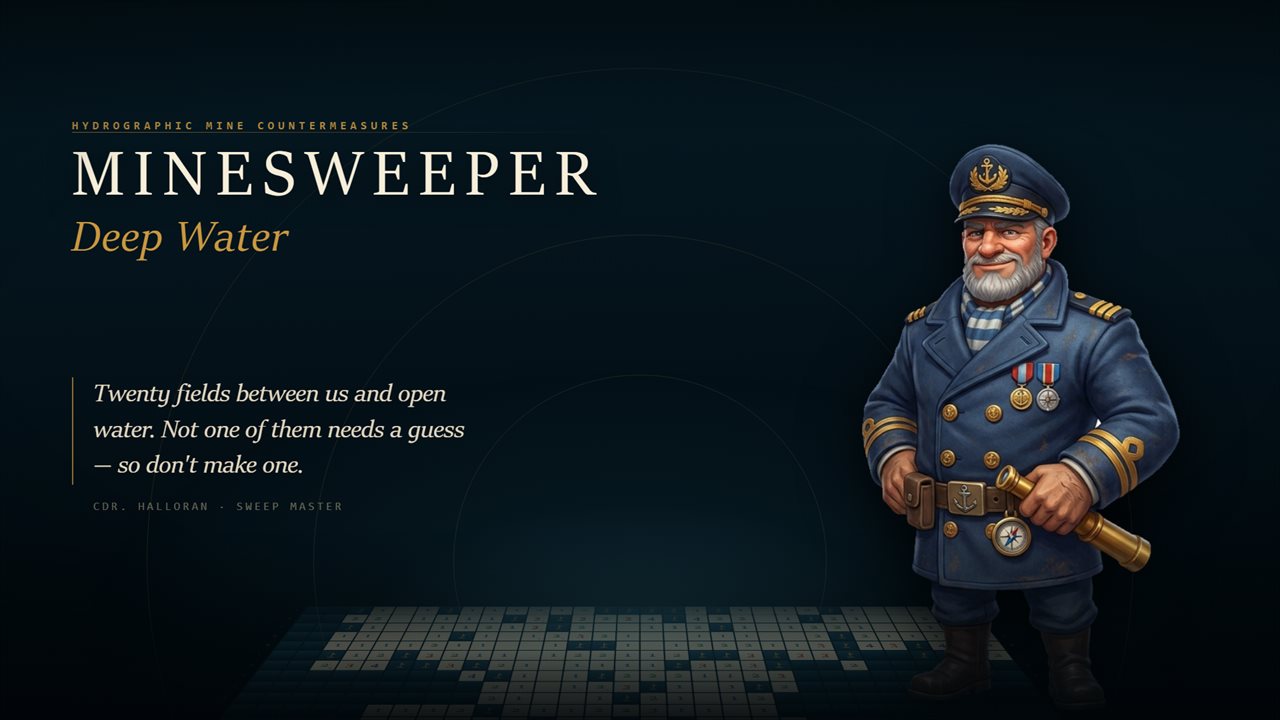
Operation Deep Water runs 20 missions in four acts, briefed by Cdr. Halloran, growing from an 8x8 slipway with 6 contacts to a 30x16 field with 99. Size is not the only thing that climbs. Later missions alter how you play:
- The Narrows takes your flags away, so the whole field has to be held in your head.
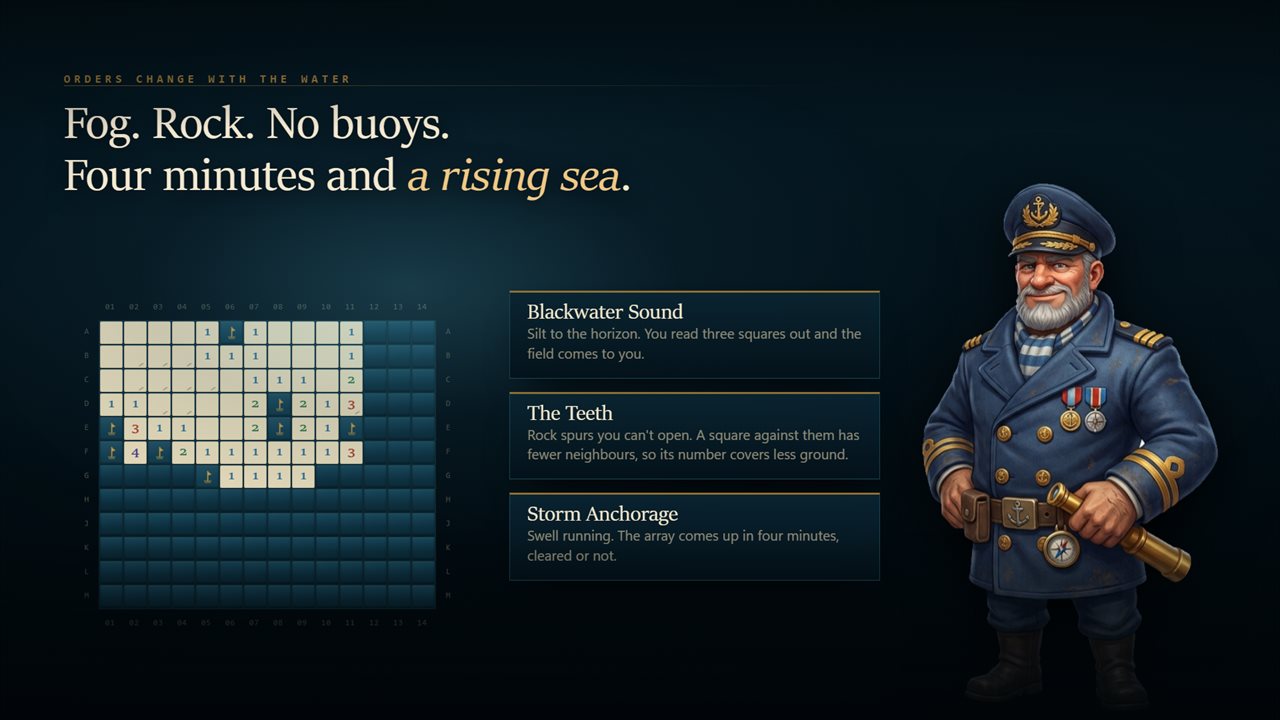
- Blackwater Sound, Fog Bank and Abyssal Gate hide numbers beyond a few cells of the cursor.
- The Teeth, The Trench and Iron Reef scatter rock squares that hold no mine and change how many neighbors a number counts.
- Storm Anchorage gives you four minutes and The Maelstrom three and a half before the sweep is called off.
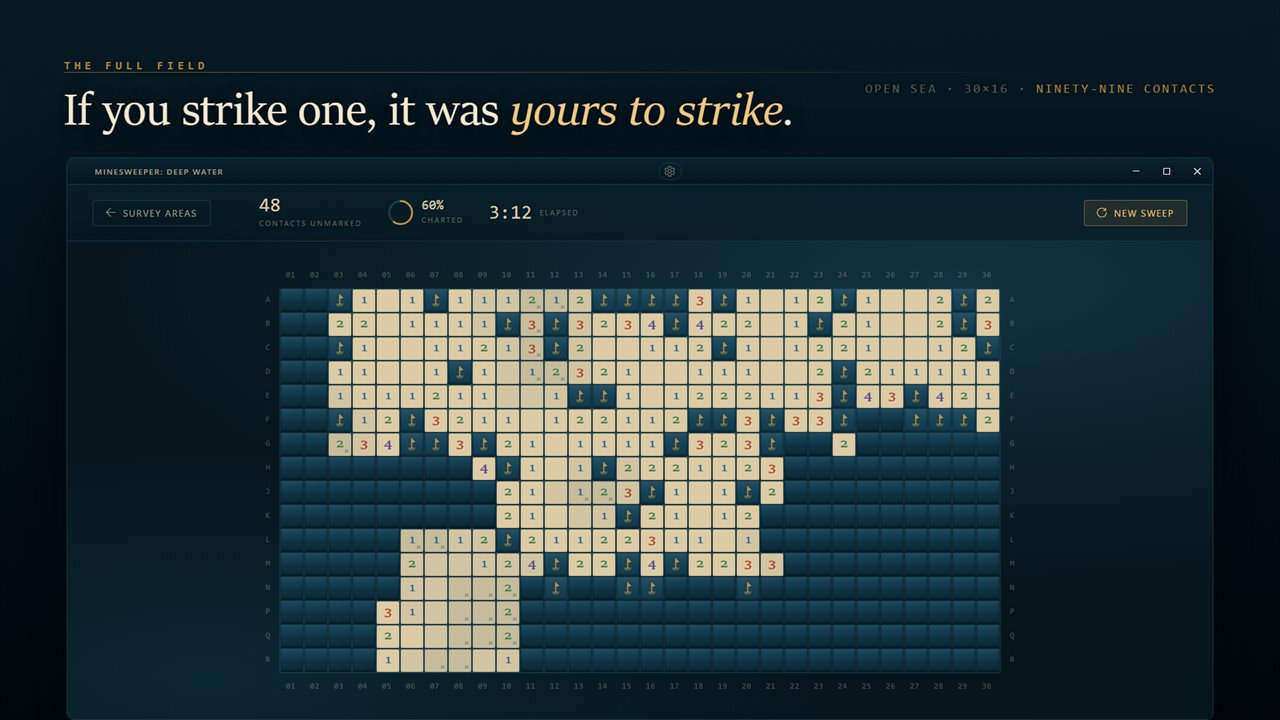
- Deadman's Shoal holds back one safe sounding you can spend when you are truly stuck, and the last mission, Deep Water, is a full 30x16 field with 99 contacts and no special orders.
Daily Minesweeper, the same field for everyone
The daily field is a short ritual with a weekly shape. Monday is a 9x9 board with 10 mines, a quick warm-up. The field widens every day after that: 12x10 on Tuesday, 14x12 on Wednesday, 16x13 on Thursday. Friday brings the first rock squares on an 18x14 board, Saturday stretches to 24x15, and Sunday is a 30x16 field with 92 mines and rock throughout.
Because it is solver-checked like the campaign, a lost daily is always a missed deduction. The menu shows your current streak, and a day you have not played yet does not count against it until midnight has passed.
Minesweeper chording, keyboard play and 3BV/s
Chording is the habit that separates slow clears from fast ones. Once a number has all its mines flagged, one chord opens every other neighbor at once instead of three or four single clicks. The game accepts all three common methods, so you can keep the one your hands already know.
Records track best time and best 3BV/s for each open area. 3BV is the minimum number of clicks a field needs, so 3BV/s measures how efficiently you cleared it, not just how fast, and it lets a quick Shoal and a slow Open Sea be compared fairly.